Saturday, February 27, 2021

Covid and Rainbows-guest blogger Molly Davidson shares her perspective after relocating from Boston to Knoxville this spring

 I went to Hobby Lobby this afternoon (that statement in and of itself is weird to me considering how long it’s been) to take some things to be framed for the house. I arrived at the counter and Barbie, oh sweet Barbie, of the Kingston Pike Hobby Lobby had no idea what she was getting herself in to.

I gave her the prints I wanted framed — one was gifted to us by our sweet downstairs neighbors, a painting of Nola’s beloved carousel. The other, by the same artist, was a painting of the side of the building we lived in with the clock tower in the background. We chatted for a few moments about the sentiment behind the prints; she asked polite questions (like a good Southerner...warms my heart) about how long we had been in town, what brought us here, etc. etc.
She worked up my ticket while we continued to make small talk. She pointed to some paper I had laid on the counter behind me and asked me if that was something I wanted help with too. Once I had seen the cost of framing the two prints, I had already decided against framing the other piece of “artwork” at the moment, but then she asked me about it. I replied and said, “Oh it’s silly. I think I’m just going to wait.” She assured me that it was not silly and especially it was not silly if it was kid’s artwork. “I’ve framed many pieces of kid’s artwork,” she said, “I figured that’s what it was, seeing the back side of the paper.” I confirmed to her that it was and just sort of stood there — afraid to say much more. My eyes welled up with tears and a moment that I’ve been expecting to come for literally weeks and months, came...in the middle of the framing department at Hobby Lobby, 2 weeks in to life in a new city.
Emotions are funny like that. Often we anticipate them, but we can’t just conjure them up out of no where — not real ones at least. We sit and we play the “what if?” game and often try to imagine the best and the worst and the emotions associated with those scenarios (maybe that’s just me). But never, never can I conjure up the rawness when I am Thinking about something. For weeks, I feel like I’ve been holding my breath and then, all of a sudden, it hit me.
She handed me some tissues, in a very appropriately socially distanced manner, and told me that she was mad she couldn’t come give me a hug. Cruelest part about these times, right? I gathered myself and she asked if I was okay and wondered if it was the kid’s artwork that had caused this visceral emotional reaction.
I pulled up a picture of Nola on my phone from March 22. In the picture, she’s smiling as big as can be, holding the beautiful rainbow we had painted to hang in our window for all to see at the very beginning of the darker quarantine days. I told her that for for 134 days that rainbow hung in the window of our apartment, overlooking the Rose Kennedy Greenway, accompanied by a second sign that said, “Everything Will Be Okay”. I told her that I looked at the backside of that rainbow every.single.day for 134 days and that sometimes I thought to myself it was hung for us, not necessarily for the passers-by, because, in the darkest times there were no passers-by. She remarked that she couldn’t imagine and, that if it wasn’t for not being able to see her daughter and grandson in Canada and the mask required at work, she might be able to forget COVID was even going on.
I’ve thought a lot about that over the last 2.5 weeks. Processing life events and traumas often takes time and stepping away from the situations in order to gain perspective on how a certain event affected you or others. I’ve wondered aloud to Austin and Catherine and Gretchen and Faith and Rebekah and my cousin numerous times why and how others (friends, loved ones, general populations outside of the northeast) escaped the literal fear and anxiety that was present every time I opened my eyeballs in March, April and May. I think I get it now.
Here in my neighborhood there are people out and about. People are walking or biking or jogging. They’re playing in their yards or sitting on their porches. Everyone is ‘distanced’ because their property allows for it. You drive around town and while obviously there are some businesses that are closed or have decreased hours, the traffic is still the same and the shuttered buildings aren’t really in your face, because you’re just driving past them. COVID isn’t as intrusive here unless you happen to be provider working directly with COVID patients or someone who has been sick/had a family member or close friend ravaged by the disease/in close relationship with a provider. It isn’t up close and personal.
I told Barbie that it was up close and personal for us and any of those living in an urban setting. At one point, later in March, I went out on the balcony at mid-day and I heard birds. Actual birds. It was beautiful and eerie all at the same time. Weeks went by when I could’ve counted probably less than 20-25 people who would walk by on the sidewalk. And those people that were walking by, were wearing masks. I went from hearing constant noise to silence, save a random car here or there or an ambulance. The highways were empty. Stores were dark. Streets were deserted. We lived in a condo building that was a block over from Quincy Market/Faneuil Hall — that place was so vibrant. Street performers, outdoor dining, shopping, tourist groups...all the things. And then one day, it was literally a ghost town.
We could not go anywhere without a reminder staring us in the face. I think about what my cousin said — he continued to run (when he could) through Brooklyn during the lockdown and often ran by refrigerated trucks outside the hospital. Can you imagine that? I looked back a few weeks ago at the data from April. I had quit watching the numbers then. It was just too scary. Too scary because I didn’t want to think about my orthopod husband having to manage respiratory disease. Too scary because at the time it made everything feel claustrophobic. But I went back to look and it was bad. There was a lot of death. There was a lot of sickness. There was just a lot of everything. And, the threats to us felt very real. Perhaps in hindsight to me personally they weren’t as bad as they felt at the time, but the danger was there for many and continues to remain.
The air was heavy and palpable for those few months. I was so jealous of all that I knew that were able to go OUTSIDE without a mask on and feel safe. IF you have had that luxury this entire time, you probably have no idea how much of a true luxury it was. And I am thankful to now be in a space where social distancing outside is easier than it was.
I showed Barbie the rainbow. It’s faded and worn. It looks like it has been through a lot. The colors that were once so vibrant have all faded and lost their shine. The paper is yellowed and sort of brittle. But, the rainbow remains. It is steadfast. It is the promise that everything will be okay and that we can rest in the promise. I told her I feel a lot like that rainbow after the last year — she told me she thought the rainbow as it is now, is even more beautiful than the one that we started with.
Perspective. Take it. Appreciate it. Be graceful and kind and patient with one another. When you laugh at those that are “afraid”, maybe ask them about it instead. Because this just skims the surface

Some words of wisdom about Stucco by a local expert- Dusty Jameson, Inspector Cluseau

 When someone mentions stucco in the realm of the real estate industry, oftentimes people get a little nervous and skeptical - and in many instances, rightfully so. There have been some terrible situations that people have encountered regarding stucco exteriors that were poorly installed and failed miserably, resulting in tens of thousands of dollars in repairs. So the raised eyebrows that you might get when you talk about an “EIFS” home in context with a real estate transaction may be frustrating, but there is some merit behind the skepticism. 

However; what if I told you that stucco (including EIFS) is actually a really good exterior siding material? In many cases, it’s far better in terms of performance than a lot of other exterior cladding materials that we insist on using on our homes and buildings. I must be selling the stuff, right? … Actually, no. I just inspect it. 

Here’s the first thing you should know. Stucco is not the enemy! The people who don’t understand how it works and who don’t understand how to install it are the enemy. Maybe not necessarily “the enemy”, but they are the ones responsible for writing the scarlet letter above the front door. Their lack of knowledge of the exterior envelope system and sub-standard installation methods is what has given stucco the bad reputation by not following the primary principle of exterior cladding installation: Move water down, out, and away. 

As a prerequisite, let’s understand that basic foundational principle: 

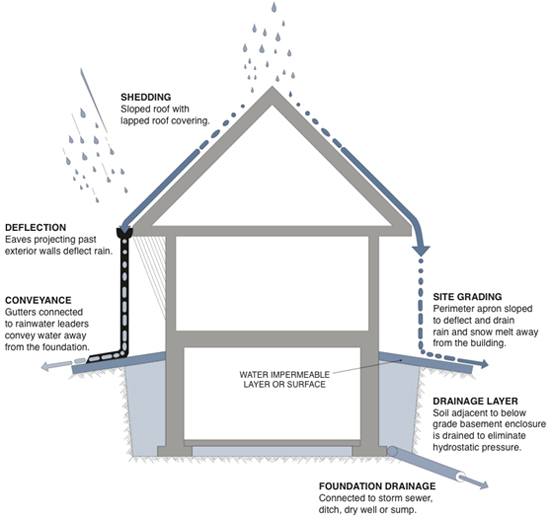
We must move water down, out, and away. 

Water will land on and around our structures. It’s impossible to avoid. How we manage the water that lands on and around our structures will either save us from massive failure with the building components, or it will let us ride the wave (pun intended) straight to our pending doom. 

From the top of the structure to the bottom, we need to manage the water and move it away as quickly and efficiently as possible. When it lands on our roof, move it to the gutters. Once in the gutters, let’s move it through spouts to the ground level. Once at ground level, let’s move it away from the foundation and send it on its way. 

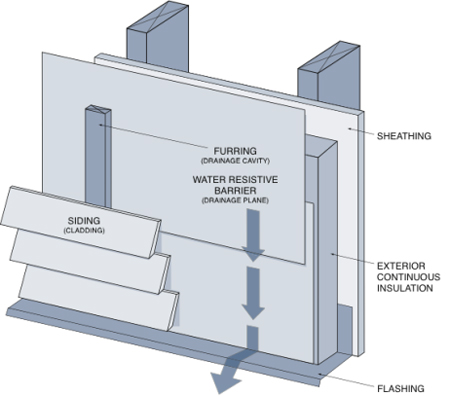
Here’s the thing we need to understand about siding (also known as “cladding”); the same principle applies. Move water down and away as fast and efficiently as possible. Water that touches the sides of the structure is attempted to be shed away on the surface if at all possible. If we can let it run down the surface and send it away from the foundation by grading the soil positively away from the foundation, then we’re all set. But we have learned that it’s not that easy. Not only is water flow difficult to control; there are other ways that it can move in and around our wall assemblies that make it impossible to achieve a complete exterior barrier on the surface. 

This is why we now use weather-resistive building wrap on our homes. We know that we cannot keep water completely on the surface of our exterior walls, so in reaction, we now require a barrier below the surface that will help to shed incidental water that finds its way behind the surface. We do everything we can to keep it out, but just in case something gets by our first layer, we’ve got a backup plan. If water gets through or around the siding then we have a barrier below the surface that will move water down (around windows and penetrations) and back out to the surface - then down and away from the structure. 

Now with that basic principle and understanding in mind, let’s talk about stucco. In hopes of not getting too far down in the weeds with technicalities and lullabies that will put you to sleep, I will keep this very basic and broad - speaking mostly in generalities. We’ll talk about the two main types and what you need to know with each. 

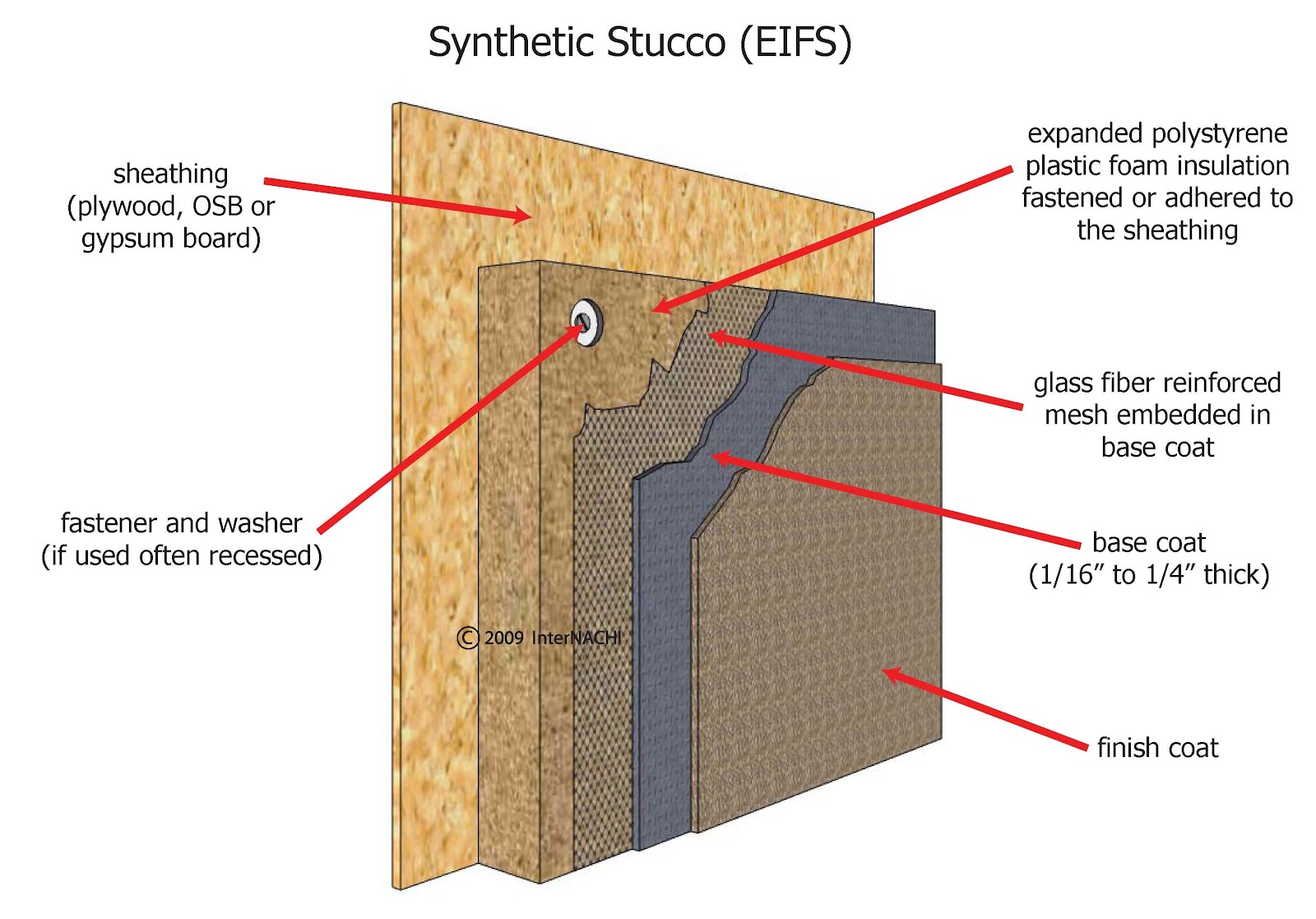
EIFS (Exterior Insulation Finishing System) aka “Synthetic Stucco”

This type of wall assembly consists of (from the inside to the outside): a substrate material (most of the time this will be wood-framed walls with plywood or OSB sheathing), building wrap, foam insulation panel, mortar base coat with fiberglass mesh, and finish coat.

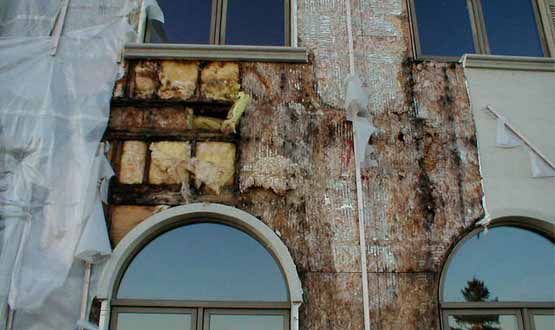
When EIFS was first installed, the goal was to assemble a “barrier system”, which meant that we were attempting to keep water completely out of the wall assembly. Fully seal the surface so nothing can get in. In theory, the concept seems logical and it can work if we can accomplish that one main objective (to keep water out). The problem is that it was installed so poorly that it let excessive amounts of water leak behind the surface resulting in catastrophic damage to the wood frame wall assembly. 

In short (and again, very generally speaking), no one put this stuff on correctly and it caused many homeowners tens of thousands of dollars in damage. Water leaked behind the walls without any indication until the entire wall cavity was riddled with water damage, mold, and all kinds of fun treasures to await the unsuspecting victims. 

This is where “stucco” gets a bad reputation. This is also why more recent building standards have evolved to accommodate the potential for water entry into wall assemblies. We understand that it is near impossible to keep water out, so we now require building wrap and drainage planes below the surface of our cladding materials so that “just in case” some water finds it’s way in, we move it back out. 

Newer EIFS systems are required to be installed with drainage systems below the surface. This can be as simple as building wrap or as complex as more sophisticated drainage systems installed specifically for EIFS systems. We try to keep it on the surface, but just in case we don’t get it perfect, we’ve got back-stops in place to capture it and move it back out - preventing damage to the building components. 

So when looking at an EIFS system, it is important to understand whether you are looking at a “barrier system” or “drainage system”. Understanding the two types of systems will help to ensure that the entire cladding system is installed and functioning as it is intended to do - rather than allowing moisture an opportunity to find it’s way below the surface - preparing us for a nice little surprise down the road. 

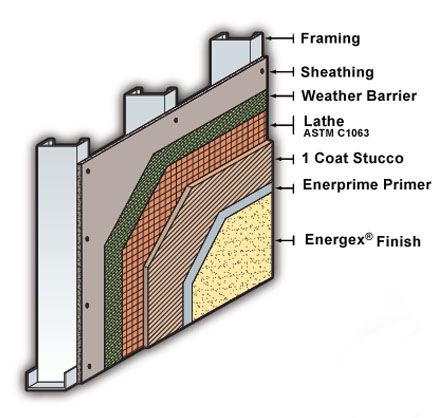
The other type of stucco is known as “hard-coat”. 

Again, I will speak very broadly and generalize this type of system. A typical installation from the inside of the wall to the out: wood-frame structure with plywood or OSB sheathing, two layers of building wrap, metal lath, mortar base coat and finish coat (ideally around 1 inch thick). 

Hard-coat stucco is thought to have fewer problems than EIFS; but in all reality, it’s installation requirements are very similar and it can have the exact same issues (water damage below the surface). The only thing that is really different is some of the products that are being used and some of the methods of assembly (EIFS utilizes foam insulation boards while hard-coat relies on a thick mortar application). Outside of that, we are still looking at a masonry siding that is mechanically attached to the framed wall. Keeping the water moving away from the surface is still a top priority, but there are back-up systems below the surface to handle the incidental moisture entry that is likely to occur. 

Regardless of whether we are looking at a hard-coat or an EIFS application, the primary principle in today’s building standards are the same: Try to keep water moving down, out, and away; but just in case we are imperfect (which is typically the case), we have a back-up plan in place to capture incidental moisture and move it back out of the wall and away from the building materials. 

That’s kind of like life, eh? We try to be perfect but typically fall short so we have to put back-stops in place to make sure we don’t screw things up. But I guess that’s another conversation for another day. For now, I’m just sticking to what I know - and I hope it’s helped shed some light on a commonly misunderstood view of stucco cladding systems. 

Feel free to drop me a message if I can ever be of assistance. 

Godspeed, my friends. 

Dusty Jameson

Exterior Design Institute Certified Exterior Cladding Inspector

865-256-1456

dusty@inspectorcluseau.com

www.inspector-cluseau.com 

Tuesday, February 23, 2021

Transferring Property Prior to Death


Sometimes, as people approach the inevitable, they start trying to get their things "in order".  They may even have a will, but they decide to transfer title to real estate prior to their death which could be an unnecessary expense for the would-be heir.

Generally, when property is passed through direction of a will, the heir will receive a stepped-up basis which means that the fair market value of the property at the time of death becomes the cost basis for the heir.  If the property were sold for that fair market value, there would be no gain and no capital gains tax due.

However, if the property is gifted prior to death of the donor, along with the title to the property comes the cost basis of the property.  The transfer of title does not trigger the capital gains tax but when the property is sold, the gain is calculated by subtracting the basis from the sales price leaving a capital gain subject to tax.  In other words, the person receiving the gift does not get the stepped-up basis.

There certainly can be advantages to transferring the property prior to death.  It completes the transfer without having to wait for the death and bypasses the probate process that might be required to settle the will.  Another advantage to the donor may be to remove the property from the owner's name which could lower the taxable estate. 

Some owners may transfer title prior to death to qualify for Medicaid.  The value of the asset may make them ineligible.  It may trigger a Medicaid Transfer Penalty when the gift is made within five years and the basis of the property is less than fair market value.

Once a property is deeded to someone, the donor loses control of the asset and it cannot be reversed.  Depending on the value of the estate, there could be gift or estate tax implications.  As mentioned earlier, it may have capital gain tax consequences for the donor when they dispose of the property.

If the person receiving the gift has creditors or judgements, the gift becomes an asset subject to those creditors or judgements.

Even though the mechanics of transferring title to a property is simple, there are many things to consider for both the person giving the property and the one receiving it.  Consult an attorney and tax professional to determine the best informed decision available.  There could be other alternatives that would better serve your situation.

Tuesday, February 16, 2021

Is It Time to Cancel the Mortgage Insurance?


Mortgage insurance benefits the lender if a borrower with less than a 20% down payment defaults on their loan.  Most conventional mortgages greater than 80% and all FHA loans require the borrower to have this coverage.

Private mortgage insurance on conventional loans can range from 0.5% to 2.25% based on the loan-to-value and the credit worthiness of the borrower.  A $350,000 mortgage would have a monthly mortgage insurance premium of $146 a month at the low-end of the scale and over $600 on the high-end.

You may request that your mortgage servicer cancel the PMI when the principal balance reaches 80% of the original value at the time the loan was made.  You should have received a PMI disclosure form when you signed the mortgage documents stating the date.  If you have made additional principal contributions, it will accelerate the date.

Other criteria considered to cancel the PMI on your loan is:

  • The request must be in writing.
  • You must be current on your payments with a good payment history.
  • The lender may ask that you certify there are no junior liens in effect.
  • If the lender is concerned that the value has declined, an appraisal may be required to show that it is eligible.

Conventional loans are supposed to remove the mortgage insurance when the unpaid balance is 78% of the original purchase price. 

Another possibility is that the lender/servicer must end the PMI the month after you reach the midpoint of your loan's amortization schedule.  For a 30-year loan, it would be after the 180th payment was paid.  The borrower must be current on the payments for the termination to occur.

With the rapid appreciation that many homes have enjoyed in recent years, homeowners may be able to refinance their home and if the new mortgage amount is less than 80% of the current appraised value, no mortgage insurance would be required.

The owner would incur the cost of refinancing but eliminate the cost of the mortgage insurance.  To calculate the savings, subtract the new principal and interest payment from the old principal and interest with PMI.  Then, divide the savings into the cost of refinancing to determine the number of months necessary to recapture the cost.

FHA loans have two types of mortgage insurance premium: up-front and monthly.  For loans with FHA case numbers assigned on or after June 3 2013 with LTV% greater than 90%, the MIP will be paid for the entire term of the loan.  If that is the case, refinancing on a conventional loan is the only way to eliminate the MIP.  For loans with original LTV% less than 90%, the MIP is collected for 11 years until the balance is 78% of the original amount.

When buying a home, purchasers may not have enough resources for a large down payment.  It is understandable to use the best mortgage available to buy the home.  The next goal should be to manage the mortgage to lower the overall costs.  In this article, we explored eliminating the private mortgage insurance.

Tuesday, February 9, 2021

Make Your Best Offer FIRST


This strategy is not about trying to negotiate the best price; it is about beating out the competition and buying the home.  It may be difficult to understand until you have lost a few homes to better offers but when the reality of the situation is that there are not that many homes on the market, the competition heats up and different tactics are necessary. 

Sales in December were annualized at 6.76 million, a 22.2% increase year over year according to the National Association of REALTOR®.  The median sales price is $309,800 which is up 12.9% from the previous year.  Inventory for December fell to 1.9 months' supply from 3.0 months' supply in December of 2019.  Six months inventory is considered a balanced market.

Things that work in a buyer's market will not work in a seller's market.  The shortage of available homes for sale has led to not only shorter market times but multiple offers that have sales prices above the listing price.  Buyers, especially in entry to mid-level priced ranges, may have lost out multiple times to buy a home. 

Buyers must be strategic if they want to successfully find a home.  There are some things that are absolutely essential to just be in the game.

Unless you are paying cash and have adequate proof of funds, you need to get pre-approved.  REALTORS® and financial advisors have been saying this for decades, but it is critical now.  There are plenty of reasons that benefit the buyer but most importantly, it is to show that a buyer is serious and has gone through the effort to have a lender run his credit and verify his income, expenses, employment, and credit.

If the home fresh on the market, in a desired location and price range, you need to assume there will be competing offers and you may never even get a counteroffer from the seller.  You need to consider making your highest and best offer first, as if you will not get a second chance.  This is more difficult for some people than others because of their bargaining nature.

Earnest money that accompanies a contract shows that the buyer is acting in good faith.  The amount that may be customary may not be enough in a competing market.  Consider two or three times what might be normal.  Talk to your agent about what would make an impression on the seller.

While contingencies will protect your earnest money from specific concerns like loan approval and inspections, the seller will look at them as ways that the buyer can get out of the contract and they'll need to put the home back on the market.  If a seller is presented multiple offers, they might be prone to accept one with the least contingencies, especially, if the prices are comparable.

There is usually a period connected to the different contingencies that are allowed to complete them.  By shortening these times as much as possible limits the time the seller might feel they are in limbo.

If you have the flexibility, you might express your willingness to move the closing and/or possession dates to accommodate the seller's schedule.  This could be an important factor in your favor and could be done in a verbal statement conveyed from your agent to the listing agent.

These are things buyers should consider and discuss with their agent before they find the home that they want to buy.  While you are formulating your position, another offer may be accepted before you even make yours.  For more information, download our Buyers Guide.

Tuesday, February 2, 2021

Home Insurance and Mortgage Insurance


Many homeowners with mortgages pay for both types of insurance but only one of them protects the owner.

Homeowner's insurance covers damage to your property and losses from fire, burglary, vandalism, and other named natural disasters.  When an insured has a loss, they file a claim with the insurance carrier which would be subject to the deductible mentioned in the policy.

If the homeowner has a mortgage on the property, the lender will require that the borrower carry adequate insurance on the property and name the lender as an additional insured.  This protects the lender that the home will continue to be sufficient collateral for the loan in case of a loss.

Mortgage insurance is not like homeowner's insurance in that it is solely for the protection of the lender if the borrower defaults on the loan.  Usually, lenders require mortgage insurance on any loan greater than 80% loan-to-value.  Occasionally, they may require it on some loans less than 80% based on their underwriting requirements and possibly, from anticipated risk from the borrower.

VA loans do not require mortgage insurance.  Conventional lenders must remove the mortgage insurance when the loan amortizes below the stated percentage.  FHA loans require mortgage insurance for the life of the loan.

When a property appreciates so that when the owners refinance, the loan-to-value ratio is less than 80%, no mortgage insurance would be required.  This can be a strong motivation for some owners to refinance to save the cost of the mortgage insurance.

Mortgage insurance premiums are not regulated by law like homeowner's insurance is in most states.  Most buyers are concerned about the interest rate on their mortgage, but few question the amount of the mortgage insurance premium.

The homeowner can select the carrier for his homeowner insurance, but the lender determines the carrier for the mortgage insurance.  When you are interviewing lenders, the type of insurance that will be required and the price of the mortgage insurance should be included in the discussion.